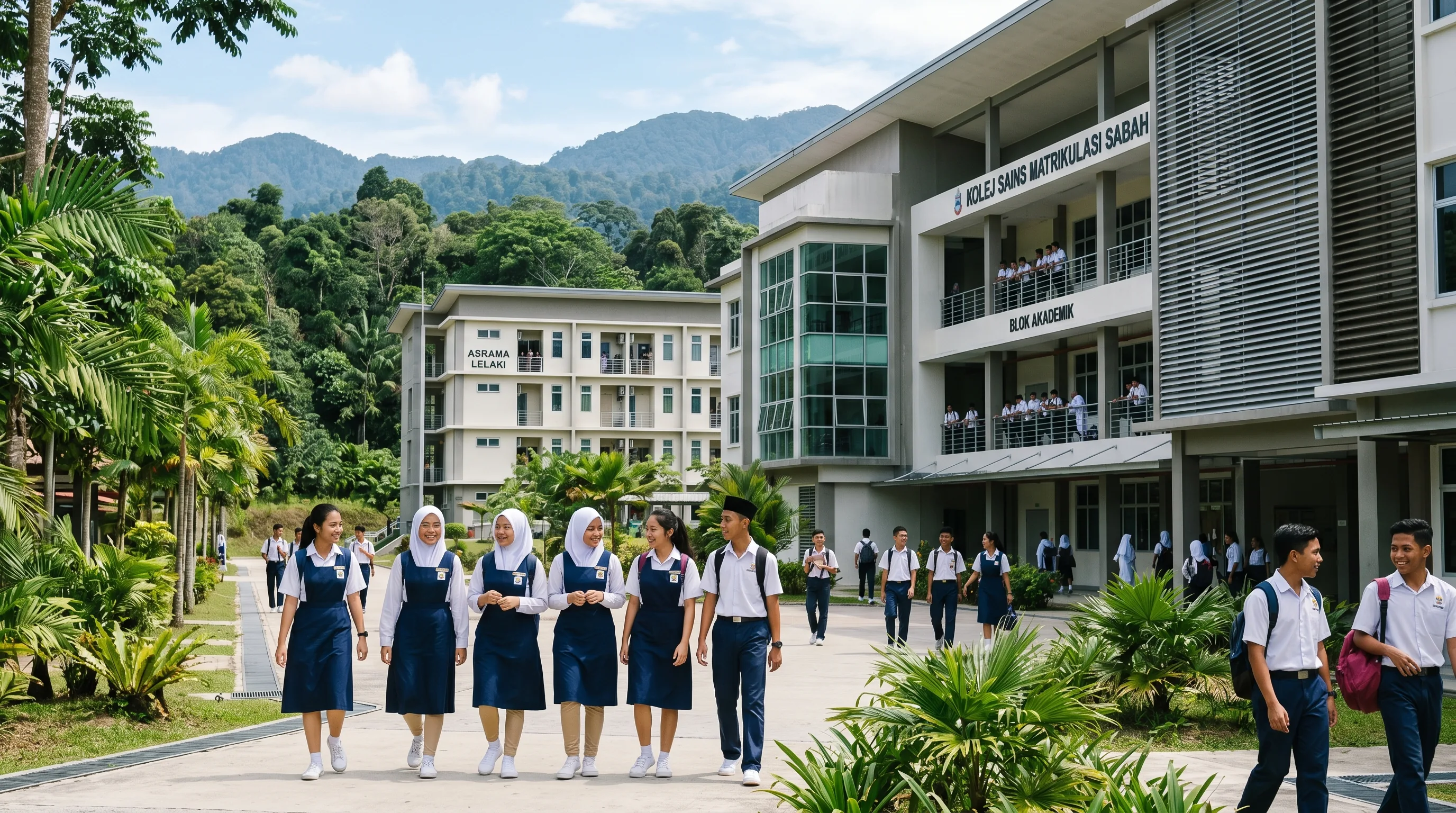
SMESH: Sekolah Menengah Sains Sabah Profile
What is Sekolah Menengah Sains Sabah (SMESH)?
SMESH is a fully residential secondary school in Likas, Kota Kinabalu, founded in 1978. It was the first fully residential secondary school in East Malaysia, admitting students through competitive, merit-based selection.
What is Sekolah Menengah Sains Sabah (SMESH)?
Sekolah Menengah Sains Sabah, widely known by its acronym SMESH, is one of the best-regarded secondary schools in Sabah. Founded in 1978 and located in the Likas area of Kota Kinabalu, the state capital, it is a fully residential institution where students live on campus throughout their studies rather than commuting from home.
As its name indicates, SMESH belongs to Malaysia's tradition of science-focused secondary schools, the Sekolah Menengah Sains, established to nurture academically strong students. Its combination of a science orientation, a fully residential model and a competitive intake has given it a standing in Sabah's education landscape out of proportion to its size, and it has produced generations of graduates who have gone on to prominent roles across the state.
For families in Sabah, SMESH represents one of the more selective and prestigious routes through secondary education. Rather than serving a local catchment as an ordinary day school does, it draws high-achieving students who win a place on merit and then board on campus, an arrangement that shapes the whole character of the school.
A first for East Malaysia
SMESH holds a genuine pioneering distinction: it was the first fully residential secondary school in East Malaysia. East Malaysia, comprising Sabah and Sarawak on the island of Borneo, had no fully residential secondary school of this kind before SMESH opened in 1978. The school therefore stands as the regional forerunner of an education model that has since become well established.
The fully residential format was significant for a state as large and dispersed as Sabah. With communities spread across a wide territory of coastline, lowland and mountainous interior, a residential school could gather talented students from far beyond a single town and educate them together on one campus. For high-achieving students from outside the immediate Kota Kinabalu area, boarding made an elite education accessible in a way a conventional day school could not.
Establishing East Malaysia's first fully residential secondary school in 1978 set a template. A residential model lets a single school concentrate talented students from across a large, dispersed state, rather than limiting intake to those living within daily commuting distance. SMESH proved the model in the Borneo context and became a reference point for residential schooling that followed.
Competitive entry and academic focus
What distinguishes SMESH most clearly from an ordinary secondary school is how students get in. Entry is competitive and based on national academic performance. Rather than enrolling students from a surrounding neighbourhood, the school selects high-achieving pupils on academic merit, which means a place at SMESH is earned through results.
This selective intake reinforces the school's science and academic orientation. By concentrating strong students in a residential setting, SMESH creates an environment geared toward serious study, where pupils are surrounded by peers of similar ability and motivation. The fully residential format complements this: living on campus removes the daily commute and immerses students in a structured academic and boarding routine.
For ambitious students and their families across Sabah, the competitive entry is both the barrier and the appeal. Winning a place signals strong academic standing, and the residential, science-focused programme that follows is designed to extend that early promise. It is this merit-based selection, more than any single facility or programme, that underpins SMESH's reputation as a school for Sabah's high achievers.
Alumni and reputation
Over more than four decades since its founding in 1978, SMESH has built a strong reputation in Sabah, reflected in the achievements of its graduates. The school is noted for having produced many prominent professionals, academics and other notable figures from Sabah, an alumni record that has helped cement its standing as one of the state's leading secondary schools.
A school's reputation is, in large part, the sum of where its graduates end up, and SMESH's selective intake feeds naturally into a strong alumni network. By admitting high-achieving students and educating them in a focused residential environment, the school has positioned its graduates well for higher education and professional careers. Successive cohorts of accomplished alumni in turn reinforce the school's appeal to the next generation of ambitious students.
This reputation matters in a practical sense for families considering their options. In a state where educational outcomes vary widely between urban and rural areas, a place at a school with SMESH's track record is widely seen as a meaningful advantage, both for the quality of schooling itself and for the network and standing that come with being part of its alumni community.
Residential and boarding schools in Sabah
SMESH is best understood within Sabah's wider residential schooling story, of which it was the starting point. As the first fully residential secondary school in East Malaysia, it pioneered a model that suits the realities of a large, geographically dispersed state where many talented students live far from the best-resourced schools.
The residential, fully boarding format addresses a specific challenge in Sabah: distance. A state with communities scattered across coast, lowland and interior cannot easily concentrate its strongest students in a single day school, because most would live too far to attend. A boarding model solves this by bringing students together to live and study on campus, regardless of where their families are based. SMESH demonstrated that this approach could work in the Borneo context, and residential schooling has since become an established part of Sabah's education landscape.
For families weighing a residential school against a local day school, the trade-offs are real. Boarding asks younger teenagers to live away from home, but it offers access to a selective, focused academic environment and a peer group of similarly motivated students. SMESH, as the original example of the model in East Malaysia, remains the reference point for what a residential secondary education in Sabah can offer.