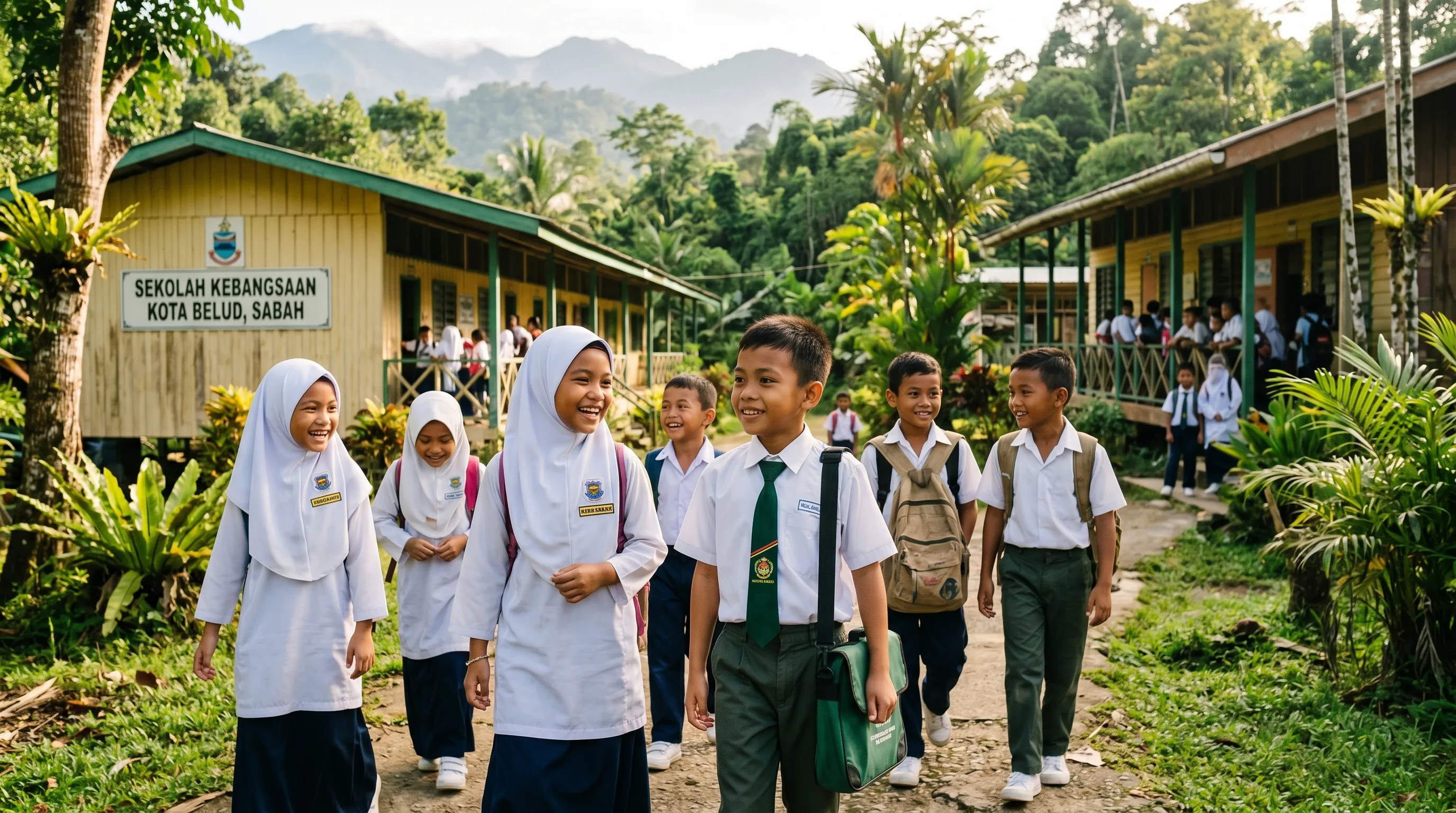
Sabah School System: Primary, Secondary & Form 6
How is the school system structured in Sabah?
Sabah follows Malaysia's national system: six years of primary school (SK, SJK(C) or SJK(T)), five compulsory years of secondary school (Form 1 to 5), then optional Form 6 leading to the STPM pre-university certificate.
How is the Sabah school system structured?
Sabah's schools sit within Malaysia's national education system, so the broad structure mirrors the rest of the country: six years of primary education, five compulsory years of secondary education, and an optional pre-university stage. What sets Sabah apart is its scale and diversity. The state stretches across a vast, often mountainous and forested territory, and its schools serve a population speaking an extraordinary range of languages, from urban Kota Kinabalu to remote interior villages.
As of the most recent figures in the research record, Sabah had around 1,072 primary schools (2016) and 235 secondary schools (2017). That ratio, with primary schools far outnumbering secondary schools, is typical: primary schools are smaller and more numerous so that young children can attend close to home, while secondary schools serve wider catchment areas.
The pathway through the system is straightforward in outline. A child enters primary school at about age seven, spends six years there, then moves to secondary school for five compulsory years, Form 1 through Form 5. After Form 5, students choose their next step. Some continue to the optional Form 6 leading to the STPM examination; others move into vocational training, matriculation, or the workforce. The sections below walk through each stage in turn, then turn to the question that shapes so much of Sabah's classroom experience: language.
Primary schools: SK, SJK(C) and SJK(T)
Primary education in Sabah, as across Malaysia, lasts six years, covering Year 1 to Year 6 for children aged roughly 7 to 12. The defining feature of the primary stage is that it comes in three official streams, each distinguished mainly by its medium of instruction:
| School type | Full name | Main medium |
|---|---|---|
| SK | Sekolah Kebangsaan (national school) | Bahasa Malaysia |
| SJK(C) | Sekolah Jenis Kebangsaan Cina (national-type Chinese school) | Mandarin |
| SJK(T) | Sekolah Jenis Kebangsaan Tamil (national-type Tamil school) | Tamil |
All three types follow the national curriculum and lead pupils toward the same secondary system. The difference lies in the language children are taught in and, by extension, the linguistic community a school primarily serves. SK national schools, taught in Bahasa Malaysia, are the most widespread. SJK(C) Chinese-medium schools serve families who want their children educated in Mandarin, while SJK(T) Tamil-medium schools serve the Tamil-speaking community.
This three-stream structure is one of the most distinctive features of Malaysian primary education. For families in Sabah, it means a genuine choice of language environment at the very start of a child's schooling, though the availability of SJK(C) and SJK(T) schools varies by location.
Secondary schools and Form 1 to Form 5
After completing primary school, students move on to secondary school, of which Sabah had around 235 (as of 2017). Secondary education runs for five compulsory years, organised as Form 1 through Form 5. Unlike primary school, the secondary stage does not split into separate language streams; students from SK, SJK(C) and SJK(T) backgrounds converge into the national secondary system.
The five compulsory years take students from roughly age 13 to 17 and form the core of formal schooling in Malaysia. They culminate in the national secondary examinations at the end of Form 5, which serve as a key gateway to further study, training and work. Sabah's average results in these examinations have historically trailed the national mark, with the state's SPM grade point average recorded at 5.09 in 2023, a figure pulled down largely by rural and interior schools while urban Kota Kinabalu schools tend to perform at or above the national level.
Secondary schools in Sabah include a small number of specialised and residential institutions alongside ordinary day schools. The most notable of these is Sekolah Menengah Sains Sabah, the first fully residential secondary school in East Malaysia, covered in detail on its own page. For most students, however, secondary school means attending a local day school through Form 5 before deciding what comes next.
Form 6 and STPM
For students who complete Form 5 and want a route to university, one option is to continue into Form 6. Form 6 is an optional pre-university stage, spanning two further years beyond Form 5, and it leads to the STPM, the Sijil Tinggi Persekolahan Malaysia or Malaysian Higher School Certificate.
The STPM is one of several recognised pre-university qualifications in Malaysia and is widely accepted as an entry route into degree programmes at public and private universities. Form 6 is offered at selected secondary schools, and it allows students to deepen their study in a chosen stream before applying for higher education. For families in Sabah weighing options after Form 5, Form 6 and STPM sit alongside other pathways such as matriculation, foundation programmes and TVET routes.
Completing Form 5 is not the end of the line, nor is Form 6 the only way forward. Students in Sabah can continue to Form 6 and STPM for a university route, enter matriculation or foundation programmes, or move into technical and vocational training through institutions like Politeknik Kota Kinabalu, IKM and GIATMARA. The best choice depends on the student's goals and circumstances.
Medium of instruction and the multilingual classroom
Few aspects of Sabah's education system are as distinctive, or as consequential, as the question of which language children are taught in. The medium of instruction differs by school type. National SK schools teach mainly in Bahasa Malaysia; SJK(C) schools teach mainly in Mandarin; SJK(T) schools teach mainly in Tamil; and international schools generally teach in English.
That layered picture sits on top of one of the most linguistically complex environments in Malaysia. Sabah has more than 80 documented languages, reflecting the state's many indigenous communities. Indigenous languages do appear in schooling in a limited way; the Kadazan-Dusun language, for example, is taught as an elective in some schools, supported by textbooks and dictionaries developed by cultural bodies. But the everyday medium of instruction in the mainstream national system remains Bahasa Malaysia.
The practical effect is that a great many Sabah children begin formal schooling in a language that is not the one they speak at home. For an urban child who already uses Malay or English daily, this is a smooth transition. For a child from an interior community whose first language is one of Sabah's many indigenous tongues, the gap between home language and school language can be a real obstacle to learning, especially in the crucial early years.
Language barriers and the multilingual challenge
Sabah's linguistic richness is a cultural asset, but in the classroom it can also be a challenge. With more than 80 documented languages across the state, the contrast between the language of instruction and the language of the home is sharper here than in most of Malaysia. This language gap is one of several factors associated with the educational difficulties faced in rural and interior Sabah.
The challenge is not language alone. It interacts with other pressures on rural schooling, including distance, infrastructure and poverty, to widen the gap between urban and interior outcomes. The state's overall literacy rate, at around 79 percent, is one of Malaysia's lowest, and functional literacy in interior districts is lower still. Bridging the distance between a child's mother tongue and the Bahasa Malaysia of the national classroom is part of the wider effort to lift educational outcomes across the state.
For families and educators, the multilingual classroom is therefore both an opportunity and a responsibility. Sabah's languages are a living heritage worth preserving, and elective indigenous-language teaching is one channel for that. At the same time, ensuring children gain strong command of the main language of instruction is central to their success through primary school, secondary school and beyond. To explore Sabah's language landscape in more depth, see the dedicated languages guide linked in the related pages below.