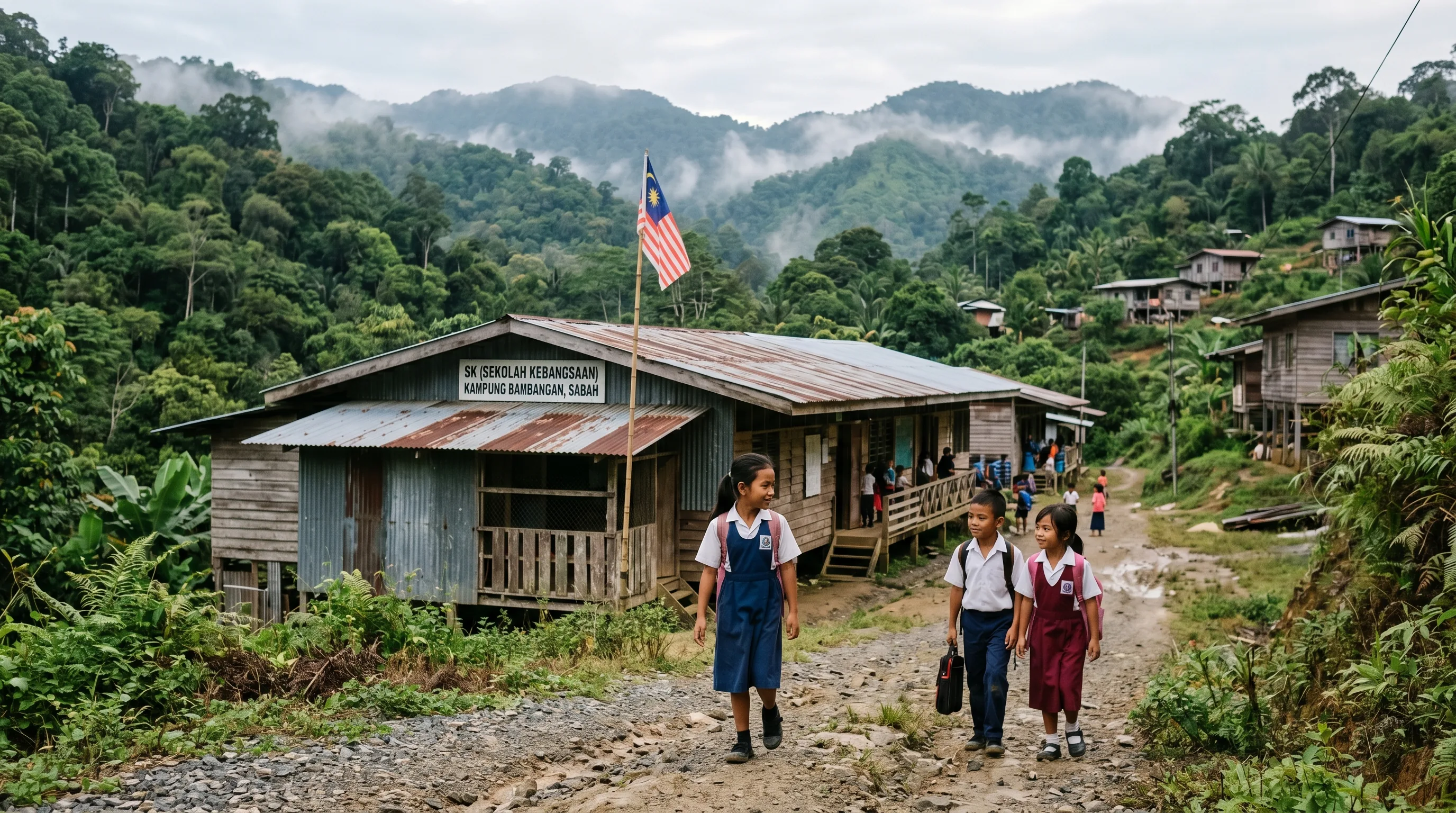
Education Challenges in Sabah: Schools & Access
What are the biggest education challenges in Sabah?
Sabah faces dilapidated school infrastructure (about 45% of schools), an estimated 250,000 undocumented children with limited access to formal schooling, a literacy rate near 79%, and a wide rural-urban learning gap.
This page summarises documented education challenges in Sabah for informational purposes only. The figures cited are drawn from public reporting and are presented neutrally. We do not assign blame to any community, authority or policy, and we avoid political commentary. The topic of undocumented and stateless children is sensitive and complex; the people affected are, above all, children. Statistics on undocumented populations are estimates and should be read as such.
What are the main education challenges in Sabah?
Sabah has a remarkably full education landscape — from village primary schools to internationally ranked research universities. Yet alongside that breadth sit some of the most stubborn structural challenges in Malaysian education. Understanding these challenges is important for parents, relocating families, educators and anyone trying to understand life in Sabah honestly.
Four issues come up most consistently. The first is ageing and unsafe school infrastructure, concentrated in the interior. The second is the situation of an estimated 250,000 undocumented and stateless children who fall outside the formal school system. The third is a literacy rate of around 79%, one of the lowest among Malaysian states. The fourth is a persistent gap between urban and rural educational outcomes, visible in examination results such as the 2023 state SPM GPA of 5.09.
These challenges are interconnected. Poverty, remoteness, documentation status and language all overlap, so a child in an interior village may face several of them at once. The sections below look at each in turn, drawing only on documented figures and presenting them in context rather than as a verdict on any party.
How serious is the school infrastructure problem?
School infrastructure is among the most visible of Sabah's education challenges. As of 2020, 466 of the state's 1,296 schools — roughly 45% — were classified as dilapidated. Of those, 52 schools were placed in Category 7, the most serious classification, indicating buildings considered structurally hazardous and effectively condemned.
For a child, a dilapidated school can mean leaking roofs, unsafe flooring, unreliable electricity and water, and classrooms that are uncomfortable or unsafe to learn in. For a teacher, it can mean working around damaged facilities while still trying to deliver the national curriculum.
| Indicator | Figure | What it means |
|---|---|---|
| Total schools (Sabah) | 1,296 | Basis for the dilapidation percentage |
| Dilapidated schools | 466 (~45%) | Classified as in poor or deteriorating condition (2020) |
| Category 7 (condemned) | 52 | Considered structurally hazardous |
The burden is unevenly distributed. Interior districts such as Kinabatangan, Pitas and Nabawan tend to have the weakest infrastructure, a reflection of difficult terrain, long distances and historical patterns of under-investment. Building and maintaining schools in remote, river-served or hilly areas is simply slower and more expensive than in the coastal towns, which is part of why the urban-rural gap persists.
Who are Sabah's undocumented and stateless children?
One of the most sensitive realities in Sabah's education picture is the large number of children without legal documentation. Estimates suggest there are around 250,000 children under the age of 19 in this situation — a category that includes stateless children, the children of undocumented migrants, and refugees. Sabah is reported to have more such children than any other Malaysian state.
It is important to be precise and careful here. These are estimates, not a registered count — the population is by its nature difficult to measure. The children involved did not choose their circumstances, and many were born in Sabah. The practical consequence for them is that, because they lack documentation, they are officially unable to enrol in government schools, which closes off the standard path to a recognised education and national qualifications.
This is a humanitarian and administrative issue that intersects with citizenship, migration and regional history. SabahGuide presents it here only to give an accurate picture of the state's education environment. We do not take a political position on it, and we encourage readers to treat the subject — and the children at its centre — with empathy.
What are Alternative Learning Centres (ALCs)?
Because undocumented children cannot enrol in government schools, a parallel network has grown up to give at least some of them access to basic education. These are the Alternative Learning Centres (ALCs). As of a 2023 estimate, there were more than 200 ALCs operating across Sabah.
ALCs are typically run by NGOs and organisations supported by bodies such as the UNHCR. They focus on basic literacy and numeracy, giving children fundamental reading, writing and arithmetic skills they would otherwise miss entirely. For many families, an ALC is the only schooling available to their children.
There are clear limits, however. ALCs are not recognised as formal schooling, which means children who attend them cannot sit the SPM national examination and therefore cannot earn the certificate that opens doors to higher education and formal employment in Malaysia. ALCs fill a vital gap, but they cannot, on their own, resolve the underlying issue of access to recognised education.
Residents and visitors who want to support education access in Sabah can do so through established NGOs and UNHCR-supported programmes that run learning centres, rather than informal arrangements. If you are considering volunteering or donating, look for organisations with a track record and child-safeguarding policies.
Why is Sabah's literacy rate lower than the national average?
Sabah's literacy rate is estimated at around 79%. To put that in context, Malaysia's national literacy rate is roughly 95%, so Sabah sits among the lowest of the Malaysian states, and functional literacy in the interior is lower still.
No single cause explains the gap. Several documented factors combine:
- The undocumented population: children outside the formal school system are far less likely to achieve full literacy.
- School dropout: distance, cost and family circumstances lead some children to leave school early, particularly in rural areas.
- Poverty: households under financial pressure may need older children to work or to care for siblings.
- Language barriers: with more than 80 languages spoken across Sabah, the Bahasa Malaysia medium of instruction can be a real hurdle for children from remote communities whose first language is a local one.
Because these factors are concentrated in the interior, the headline figure understates how wide the gap can be between, say, Kota Kinabalu and a remote interior village.
How do Sabah students perform academically?
Examination results give a measurable snapshot of the rural-urban divide. Sabah's average SPM GPA in 2023 was 5.09, which sits below the national average. (In Malaysia's SPM grade-point system, a lower numerical GPA reflects stronger performance, so a higher state-average number indicates results trailing the national benchmark.)
The state average, though, hides a wide internal range. Urban schools in Kota Kinabalu generally perform at or above the national average, while many rural and interior schools score well below it, dragging the overall figure down. The pattern mirrors the infrastructure and literacy data: where schools are better resourced and better connected, outcomes are stronger.
The takeaway is not that Sabah's students are less capable, but that access and resources vary enormously across the state. A child's postcode, more than anything, shapes the educational environment available to them.
How do language barriers affect learning?
Sabah is one of the most linguistically diverse places in Malaysia, with more than 80 documented languages. That diversity is a cultural treasure, but it also creates a genuine educational challenge.
Government schools teach in Bahasa Malaysia, while Chinese vernacular schools (SJK(C)) use Mandarin, Tamil schools (SJK(T)) use Tamil, and international schools use English. For a child in a remote interior community whose home language is, for example, a Dusunic or Murut language, beginning formal schooling can mean learning in a language they barely speak. Early years spent bridging that gap can put rural children at a disadvantage from the very start.
Some local languages, such as Kadazan-Dusun, are taught as electives, supported by materials from cultural bodies such as the KDCA, and several are the subject of preservation efforts at Universiti Malaysia Sabah. But the day-to-day reality for many interior children is that the medium of instruction is not their mother tongue — one more factor layered on top of distance, poverty and infrastructure.