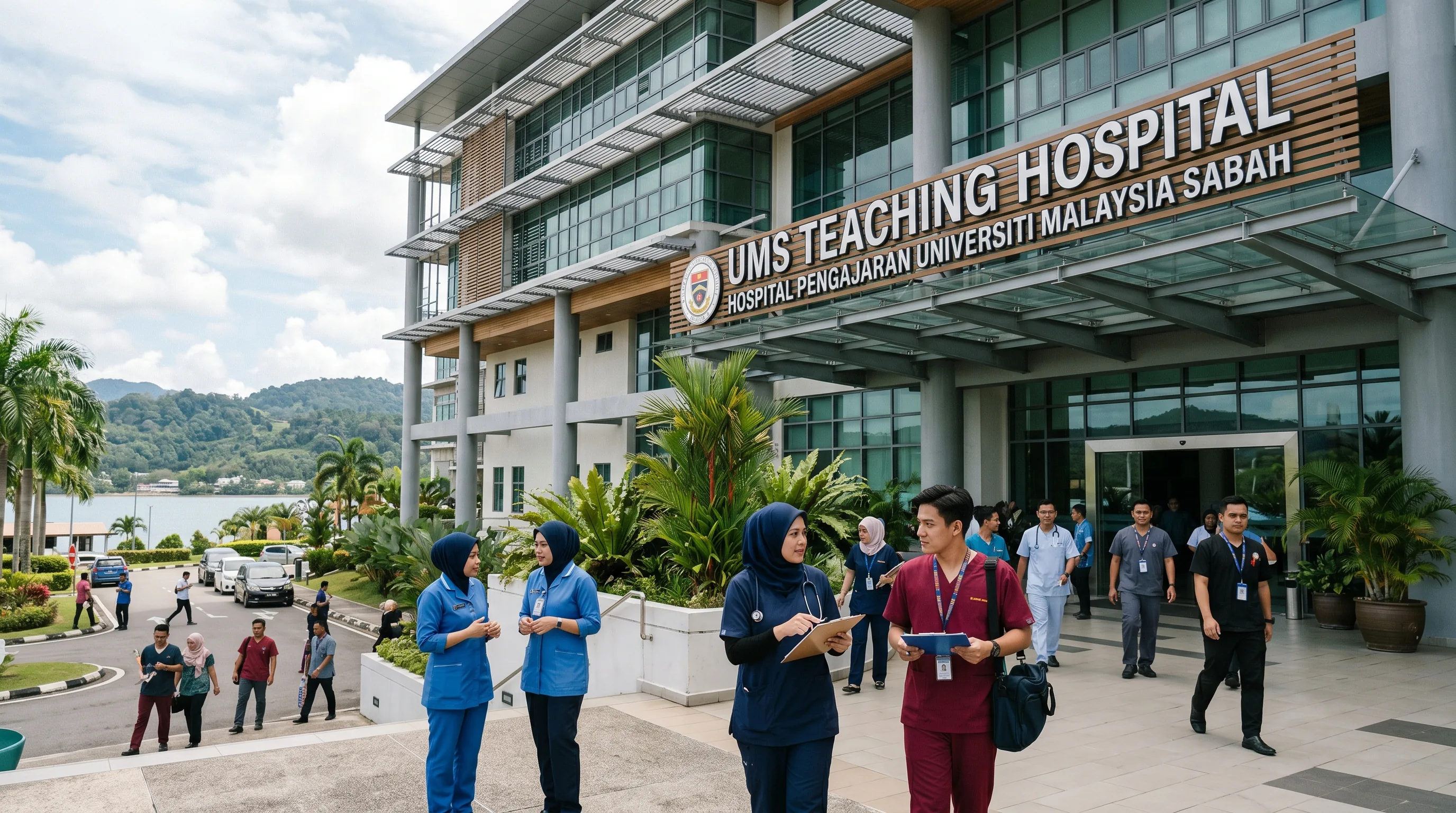
UMS Hospital (HUMS): Sabah's University Teaching Hospital
What is UMS Hospital (HUMS)?
UMS Hospital (Hospital Universiti Malaysia Sabah) is East Malaysia's first university teaching hospital. A 400-bed centre on the UMS campus in Sepanggar Bay, Kota Kinabalu, it targets full operations in Q2 2026.
What is UMS Hospital?
UMS Hospital — officially Hospital Universiti Malaysia Sabah (HUMS) — is a teaching hospital built on the campus of Universiti Malaysia Sabah in Kota Kinabalu. It is the first university teaching hospital in East Malaysia, a milestone for both higher education and healthcare in the region.
A teaching hospital is more than a place to treat patients. It combines clinical care with hands-on training, so that medical students, junior doctors and specialists learn and practise in the same building where patients are treated. For Sabah, this means that the next generation of doctors can be trained locally, while patients gain access to a tertiary-level facility that the state has long lacked.
HUMS is operated in partnership with the university's Faculty of Medicine and Health Sciences. As a teaching hospital, it is designed to deliver advanced specialist services while also functioning as a research and education hub for medicine in Borneo.
Where it is and how big it is
The hospital is located on the UMS campus at Sepanggar Bay, in the northern part of Kota Kinabalu. This places it close to a large student population and within reach of the wider KK metropolitan area, which is home to the densest concentration of people in Sabah.
HUMS is planned as a 400-bed hospital. That capacity supports a broad mix of inpatient services, from general wards to specialist units, and gives the teaching hospital the scale it needs to handle complex cases that previously required referral elsewhere.
Its position on the UMS campus is deliberate. By co-locating the hospital with the medical faculty, students and staff move easily between lecture halls, laboratories and clinical wards — a key feature of how teaching hospitals are designed to work.
Construction progress and timeline
As of early 2026, the hospital was reported to be approximately 96% complete, with work focused on final fit-out, equipment installation and commissioning rather than major structural construction.
A significant early milestone came on 12 December 2025, when the hospital's Primary Care Centre held a soft opening. This allowed primary, outpatient-style care to begin while the rest of the facility continued its final preparations.
The target for full operations is Q2 2026, at which point the broader range of inpatient and specialist services is expected to come online progressively.
Large hospitals rarely open all at once. The Primary Care Centre's December 2025 soft opening allows some services to begin early, while specialist departments and inpatient wards are commissioned in stages toward full operations in Q2 2026.
| Milestone | Date / status |
|---|---|
| Construction progress | ~96% complete (early 2026) |
| Primary Care Centre soft opening | 12 December 2025 |
| Target full operations | Q2 2026 |
| Planned bed capacity | 400 beds |
Why it matters for Sabah healthcare
Sabah has historically faced gaps in tertiary specialist care — the highly specialised treatment provided by consultants for complex conditions. In many cases, patients needing certain advanced procedures or specialist input had to be referred to facilities in Peninsular Malaysia, which adds cost, travel and time for patients and their families.
UMS Hospital is set to change this picture. By providing tertiary specialist care previously unavailable in Sabah, it aims to reduce the need for medical referrals to Peninsular Malaysia, keeping more advanced treatment closer to home for residents across the state.
Beyond direct patient care, the hospital strengthens the overall healthcare system in Sabah by adding capacity, modern facilities and a permanent base for training and research. Over time, a well-established teaching hospital can help attract and retain medical talent in the region.
Planned medical specialties
HUMS is designed to deliver care across a range of major clinical specialties. The planned specialties include:
- Cardiology — heart and cardiovascular care
- Neurology — disorders of the brain and nervous system
- Oncology — cancer diagnosis and treatment
- Orthopaedics — bones, joints and the musculoskeletal system
- Obstetrics & Gynaecology — pregnancy, childbirth and women's health
- Paediatrics — medical care for infants and children
Together, these specialties cover much of the demand for advanced care, and they give medical students and trainees broad clinical exposure under one roof.
Role in medical training
As the teaching hospital for Universiti Malaysia Sabah, HUMS serves as a training base for the UMS medical faculty and its students. Trainees gain supervised, hands-on experience in real clinical settings, working alongside consultants across the hospital's specialties.
This integration of education and care is the defining feature of a teaching hospital. Students rotate through wards, clinics and specialist departments, building practical skills that classroom learning alone cannot provide. Faculty members, in turn, combine teaching duties with active clinical practice.
For Sabah, training doctors locally has long-term value: graduates who learn in the state are more likely to understand local health needs, and a strong teaching hospital helps build a sustainable pipeline of medical professionals for the region's future.