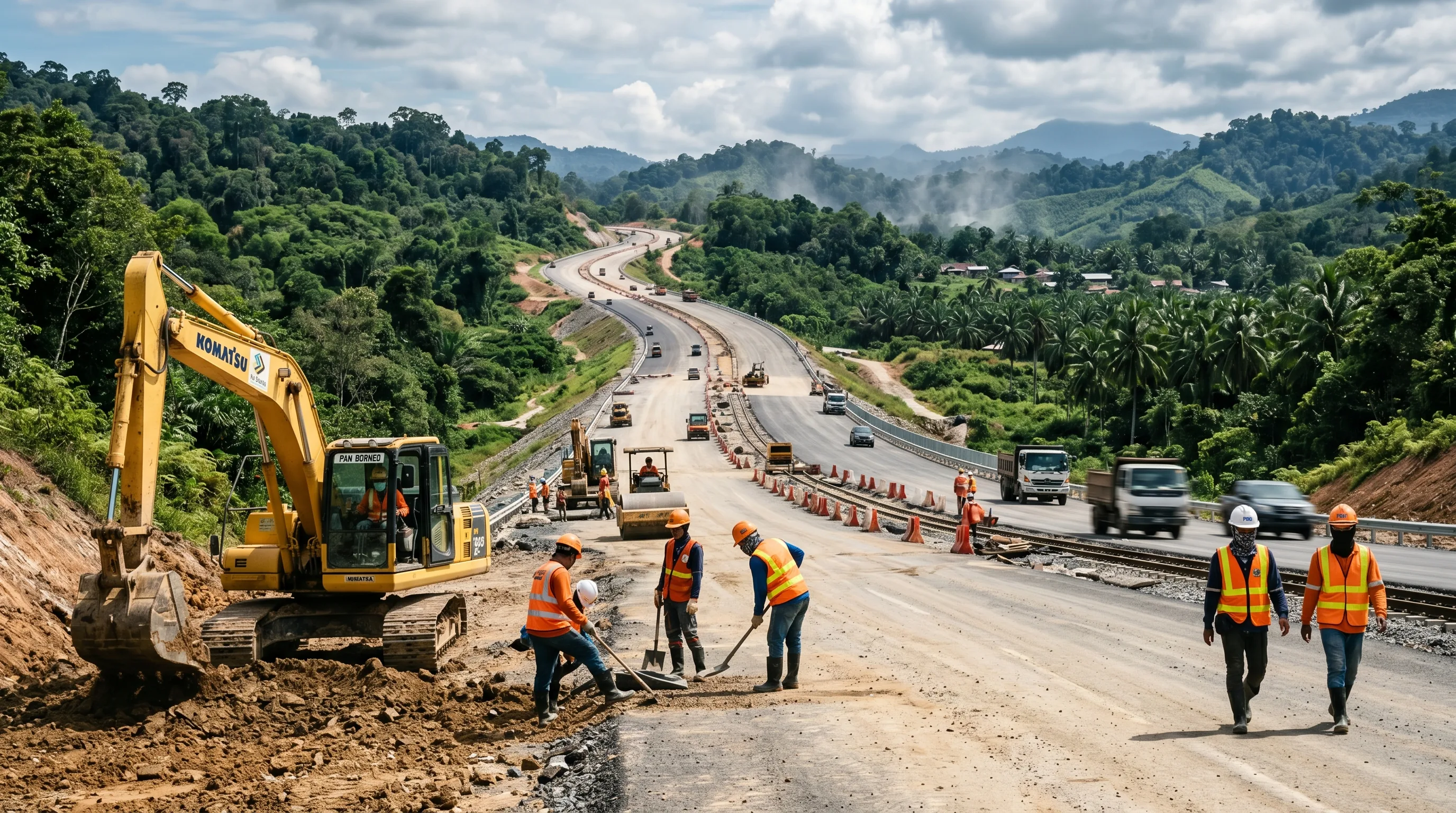
Pan Borneo Highway Sabah: Route, Cost & Progress
What is the Pan Borneo Highway in Sabah?
The Pan Borneo Highway is a 706 km trunk road across Sabah costing RM24.838 billion. It links the Sarawak border at Sindumin to Tawau, passing Kota Kinabalu, Sandakan and Lahad Datu.
What is the Pan Borneo Highway?
The Pan Borneo Highway (Lebuhraya Pan Borneo) is one of the largest infrastructure undertakings in East Malaysia, designed to create a continuous, modern trunk road spanning the island of Borneo. The Sabah stretch is the portion of that wider network that runs entirely within the state, and it represents a major upgrade over the patchwork of older roads that previously linked Sabah's main towns.
Within Sabah, the project covers 706 km of carriageway at a total cost of RM24.838 billion. Rather than building entirely new alignments everywhere, the programme widens, straightens and upgrades existing corridors while adding new sections where terrain demands. The result is a higher-capacity route built to consistent engineering standards, intended to carry both heavy freight and everyday passenger traffic for decades to come.
For a state where towns are separated by long distances and rugged interior terrain, a reliable cross-state highway is a foundational piece of infrastructure. It connects the west coast administrative centre of Kota Kinabalu with the east coast commercial towns, shortening journeys that have historically taken the better part of a day.
The route across Sabah
The Sabah stretch begins at Sindumin, on the Sabah-Sarawak border, where it ties into the wider Pan Borneo network. From there it travels north and east, threading through the populated west coast before swinging across the interior toward the east coast districts.
Along the way the highway passes through or near several of Sabah's most important towns:
- Kota Kinabalu — the state capital and main west coast hub.
- Sandakan — a major east coast commercial and port town.
- Lahad Datu — a key agricultural and industrial centre on the east coast.
The corridor finally reaches its eastern terminus at Tawau, near the southern end of Sabah's east coast. By linking Sindumin to Tawau in a single upgraded route, the highway stitches together the west coast, the interior and the east coast into one continuous land connection.
The Sabah stretch is designed to function as a seamless extension of the Sarawak section. Drivers crossing at Sindumin continue onto the same upgraded highway standard, making overland travel across Borneo far more practical than before.
How the project is phased
Because of the scale of the works, the Sabah stretch is delivered in two major phases. Splitting the programme this way lets construction begin on priority sections while later, more complex stretches are designed and procured.
| Phase | Cost | Target completion |
|---|---|---|
| Phase 1A | RM10.849 billion | March 2026 |
| Phase 1B | RM13.989 billion | September 2028 |
Together the two phases make up the full RM24.838 billion investment. Phase 1A covers the first wave of upgrades and is the more advanced of the two, while Phase 1B carries the larger budget and addresses the remaining, often more demanding, sections of the corridor.
Construction progress
Progress varies sharply between the two phases, reflecting their different start dates and scope.
- Phase 1A is around 85% complete, with works targeting completion in March 2026. The bulk of this phase is therefore in its final stretch.
- Phase 1B sits at roughly 9% complete, working toward a September 2028 target. As the larger and later phase, it has the longest road ahead.
The contrast underlines how staged delivery works in practice: drivers will see the benefits of Phase 1A sections well before the entire 706 km corridor is finished. As each completed segment opens, the cumulative travel-time and reliability gains build up across the network.
A single headline percentage rarely captures a project this size. Tracking each phase separately gives a clearer picture: one phase nearing completion, the other still ramping up.
Engineering and logistical challenges
Building a continuous high-standard highway across Sabah involves significant technical and logistical hurdles, particularly in the interior where the terrain is most demanding.
Key challenges include:
- Utility relocation — power lines belonging to SESB, water pipes and telecoms infrastructure often sit within or near the road reserve and must be carefully relocated before earthworks can proceed.
- Worker and equipment shortages — in the period after COVID, securing enough skilled labour and machinery on site slowed the pace of several work fronts.
- Soft soil and terrain — stretches through interior Sabah cross soft ground and hilly, uneven terrain, which complicates foundations, drainage and embankment stability.
Each of these factors adds time and engineering effort. Utility relocation in particular must be sequenced carefully so that nearby communities are not left without services while road construction advances.
Economic impact for Sabah
The highway's value lies not just in smoother roads but in the economic activity that better connectivity unlocks. The headline benefit is travel time: the drive between Kota Kinabalu and Tawau is expected to fall from around 10 to 12 hours to roughly 6 hours once the corridor is complete.
Shorter, more reliable journeys carry several knock-on effects:
- Logistics and trade — interior districts that were previously hard to reach become more viable for moving goods, opening them up to wider markets.
- Jobs during construction — the programme is estimated to support 10,000-plus jobs during the build phase.
- Lower transport costs — faster freight movement reduces the time and fuel burned shifting produce and goods across the state.
By tying the west coast, interior and east coast into a single dependable road network, the Pan Borneo Highway is positioned as a long-term enabler of trade, agriculture and regional development across Sabah.