Sandakan's Chinese Temples: History & Visitor Guide
What are Sandakan's main Chinese temples?
Sandakan's two landmark Chinese temples are the Goddess of Mercy Temple, built in 1868 and the oldest to survive WWII, and the Taoist Sam Sing Kung Temple, founded by four Chinese communities in the late nineteenth century.
Sandakan's Chinese temples at a glance
Sandakan's history is bound up with the Chinese immigrants who arrived during the colonial era and built a town once known as the "Little Hong Kong of the East." Their faith left a lasting mark in the form of temples that still stand today — places of worship that double as windows into more than 150 years of community life on Sabah's east coast.
Two temples anchor this heritage: the Goddess of Mercy Temple, the town's oldest surviving temple, and the Taoist Sam Sing Kung Temple, founded jointly by four Chinese dialect communities. Alongside them, the widespread worship of Tua Pek Kong, the God of Prosperity, reflects folk religious traditions found in virtually every Chinese settlement across the state.
Goddess of Mercy Temple (Kun Yam / Kuan Yin): built 1868, oldest in Sandakan to survive WWII. Sam Sing Kung Temple: Taoist, late nineteenth century, founded by Hakka, Cantonese, Hainanese and Teochew communities.
Goddess of Mercy Temple
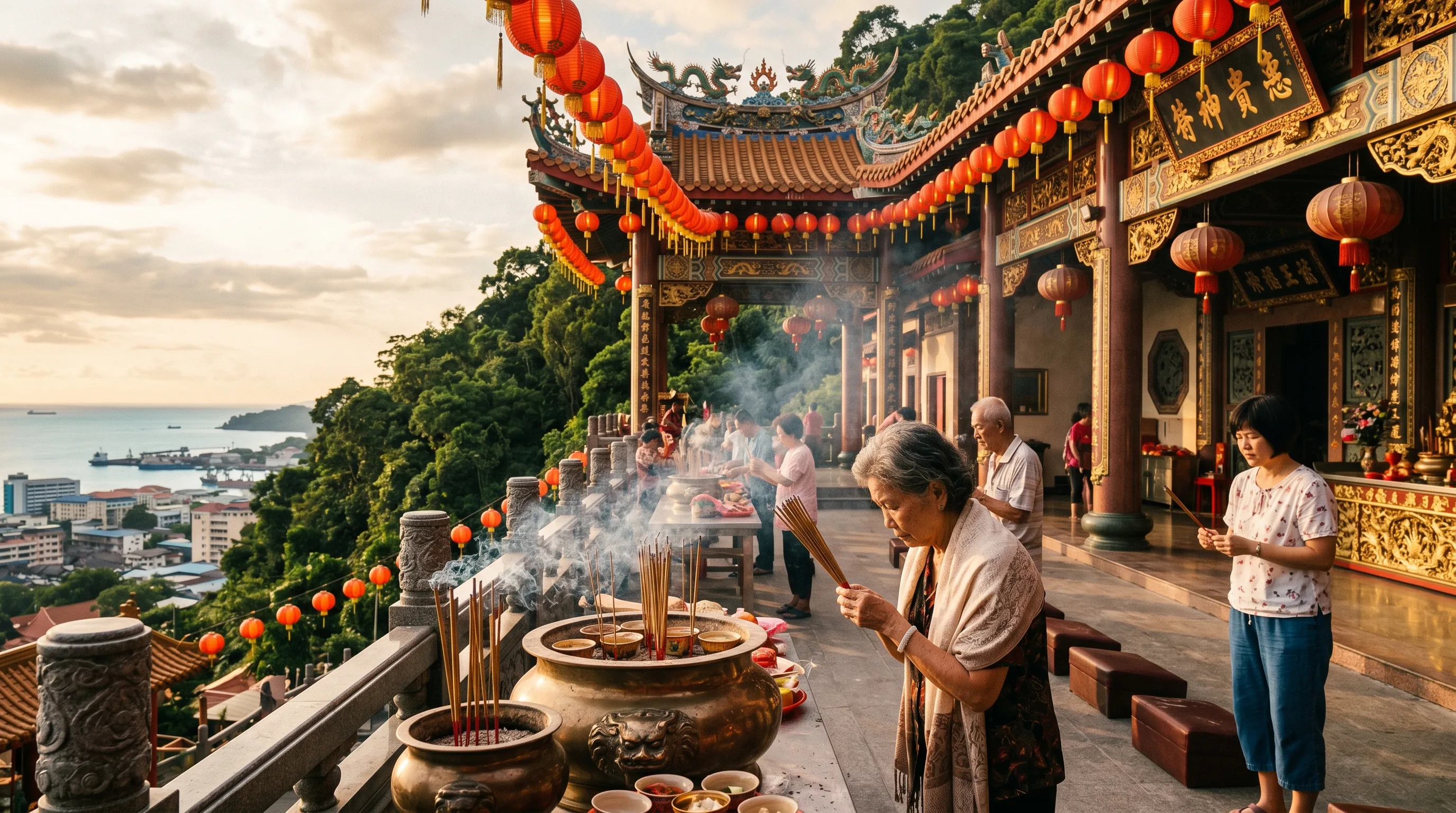
The Goddess of Mercy Temple — also called the Kun Yam or Kuan Yin Temple — sits on a small hill slope near St. Michael's Church. Built in 1868, it is the oldest temple in Sandakan to survive the Second World War and one of the oldest Chinese temples in Sabah. It even pre-dates the nearby Tam-Kung Temple, which was established in 1876.
The temple stands as a testament to the earliest Chinese immigrant religious presence in colonial Sandakan. Its peaceful hilltop setting offers a quiet contrast to the town below, and it forms part of the Sandakan Heritage Trail as Site No. 6. Entry is free, with donations accepted, making it an accessible and meaningful stop for visitors tracing the town's origins.
Sam Sing Kung Temple
The Sam Sing Kung Temple is a Taoist temple founded in the late nineteenth century by four Chinese communities — the Hakka, Cantonese, Hainanese and Teochew. This joint founding reflects Sandakan's status at the time as the "Little Hong Kong of the East," a thriving port where different dialect groups lived and worshipped side by side.
The temple is polytheistic, honouring multiple Taoist deities while also showing Buddhist influences, including the figure of Guanyin. Over the generations it has witnessed Sandakan's history unfold — from the days of the North Borneo colony, through the formation of Malaysia in 1963, to the present tourism era — making it a living chronicle of the town's enduring Chinese heritage.
Tua Pek Kong and folk worship in Sabah
Beyond Sandakan's two landmark temples, the worship of Tua Pek Kong — the "God of Prosperity" in Peranakan and Hokkien folk religion — is found in virtually every Chinese settlement across Sabah, with dozens of temples and shrines state-wide. Tua Pek Kong is a symbol of the Hakka and Hokkien merchant-diaspora prosperity traditions that shaped Chinese settlement throughout North Borneo.
Worship follows the rhythm of the lunar calendar. Families typically make offerings on the 1st and 15th of the lunar month, while business owners observe the 2nd and 16th. Offerings commonly include fruit, incense, tea, joss paper and cooked meals — small daily acts of devotion that keep these folk traditions alive.
| Who worships | Lunar days |
|---|---|
| Families | 1st and 15th of the lunar month |
| Business owners | 2nd and 16th of the lunar month |
Temples on the Sandakan Heritage Trail
The Goddess of Mercy Temple is woven into the Sandakan Heritage Trail as Site No. 6, sitting on its hill slope close to St. Michael's Church. This makes it easy to combine a visit to the temple with the town's other historic landmarks on a single walking route.
Together, Sandakan's Chinese temples and its heritage churches tell a layered story of a colonial port shaped by migration, trade and faith. Walking the trail lets visitors experience that history in place, moving between the hilltop temple, the surrounding streets and the wider townscape that grew up around them.
Temple etiquette
These temples remain active places of worship, so respectful behaviour matters. Dress modestly, keep your voice low, and move quietly through the prayer halls. Donations are welcomed at the Goddess of Mercy Temple, but never expected of casual visitors.
Ask before photographing people at prayer or any ceremony in progress, and do not touch altars, statues or offerings unless you are invited to do so. Treating each temple as the sacred space it is ensures that worshippers and visitors can share these historic sites with ease.