Indigenous Spiritual Sites of Sabah: Sacred Guide
What are Sabah's indigenous spiritual sites?
They are the sacred places and traditions of Sabah's indigenous peoples, including sacred Mount Kinabalu, the ancestral homeland of Nunuk Ragang, the bobohizan priestess tradition and Murut longhouse spirit shrines, rooted in animist belief.
Sabah's indigenous spiritual heritage
Long before mosques, churches and temples shaped Sabah's skyline, the peoples of this land already held rich spiritual beliefs centred on the mountains, rivers, forests and ancestors around them. The Kadazan-Dusun and Murut traditions, in particular, are woven through with sacred places and ceremonies that explain the origins of the world and the bonds between the living, the dead and the land.
This guide describes those traditions respectfully, as part of Sabah's living cultural heritage. From the towering form of Mount Kinabalu to the ancestral homeland of Nunuk Ragang, the priestess role of the bobohizan and the spirit shrines of Murut longhouses, these beliefs continue to shape identity even as religion in Sabah has changed.
The beliefs and sites on this page are presented respectfully as part of Sabah's cultural heritage. The bobohizan priestess tradition is declining rapidly, and many of these practices survive today mainly as cultural memory. Sacred sites should always be treated with respect, and any rituals you encounter observed quietly and without intrusion.
Mount Kinabalu, the sacred mountain
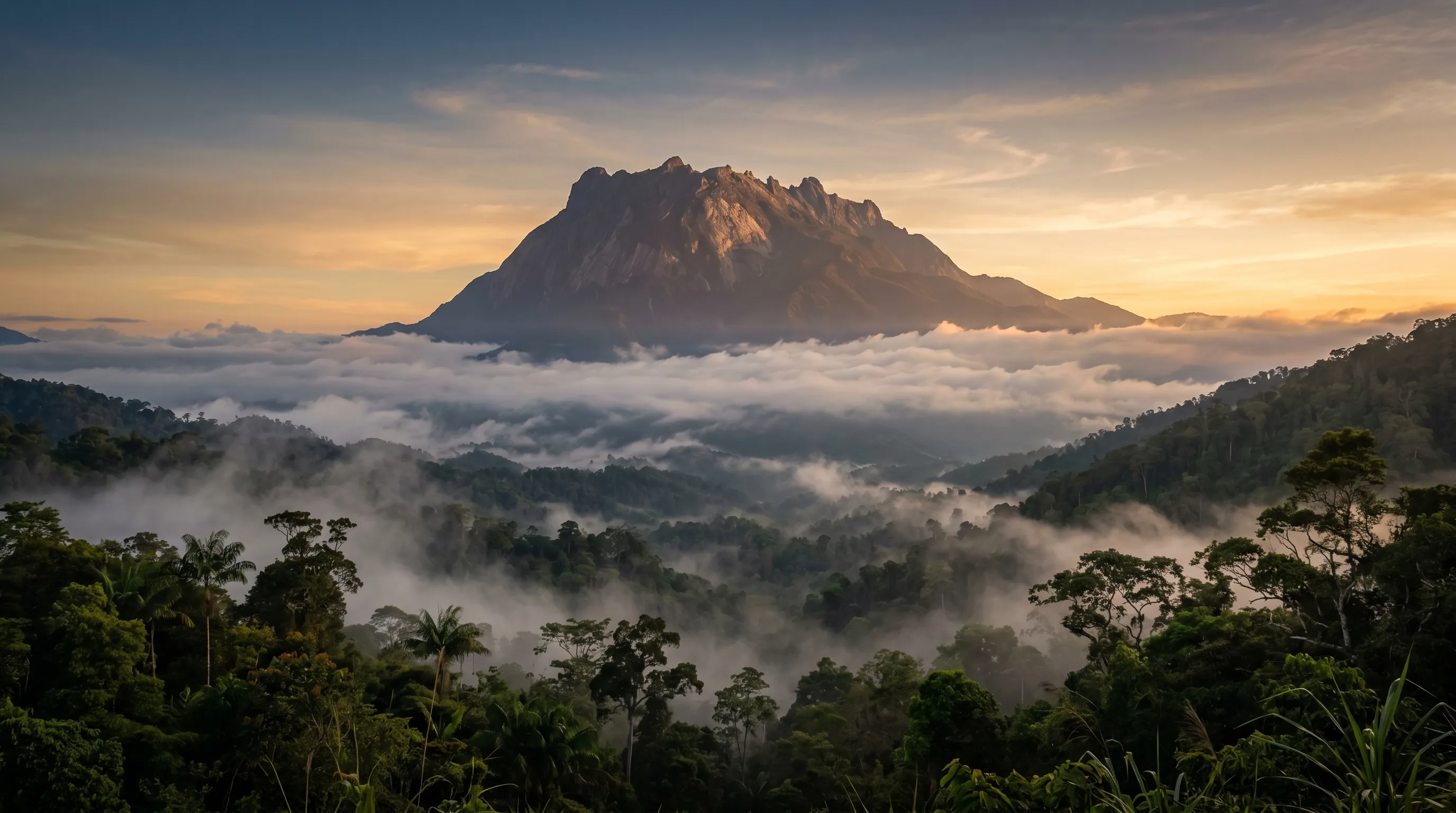
For the Kadazan-Dusun, Mount Kinabalu is far more than Borneo's highest peak. In their belief, it is the resting place of ancestral spirits: the spirits of the deceased are said to ascend to the summit. The mountain's name is often traced to "Aki Nabalu" — from aki (ancestor) and nabalu or nabahu (coffin) — understood to mean the "abode of the dead". The mountain is watched over by a guardian spirit, Aki Nabalu, or Grandfather Nabalu, regarded as its protector.
The mountain also features in Kadazan creation stories. The male god Kinoingan is said to have created the sky and clouds, while his wife Suminundu created the land, and the mountain is venerated within these accounts. Historically, the bobohizan priestesses channelled spirits through medicinal plants and performed rituals before climbs, and bobohizan-led processions under the full moon during Kaamatan gave thanks to the mountain spirits for bountiful harvests. On the mountain's north side lies Low's Gully, an 1,800-metre-deep gorge considered a resting place for the souls of the dead, with extremely hazardous access.
Nunuk Ragang, the ancestral homeland
If Mount Kinabalu is where spirits rest, Nunuk Ragang is where the people began. It is regarded as the mythical birthplace and ancestral homeland of the Kadazan, Dusun and Rungus peoples. The name combines "Nunuk" (banyan tree) and "Ragang" (red-coloured) — a giant red banyan tree beneath which, tradition holds, a central longhouse formed their first community.
The site lies in the Tampias village area, at the confluence of the Liwagu Kogibangan and Liwagu Kowananan rivers, east of Ranau and Tambunan. In 2004, a monument was established near Tampias village by the KDCA (the Kadazandusun Cultural Association), and an annual pilgrimage is conducted there. For many in the community, Nunuk Ragang remains a powerful symbol of shared origins, connecting the related peoples of the interior to a single ancestral home. You can learn more about these communities on the ethnic groups of Sabah guide.
The bobohizan priestess tradition
At the centre of Kadazan-Dusun spiritual life stands the bobohizan, also known as the bobolian: female high priestesses, ritual specialists and spirit mediums. They serve as the intermediary between humans and spirits, and act as healers, agricultural specialists and conductors of funerary rites. Their world view is one of animism — the belief that all objects possess spirits. Among these, the Mogigion, or "Guardians of the Land", are the most important: generally benevolent, but angered by disrespect shown to the land.
The bobohizan preside over key ceremonies. These include the appeasement of Bambaazon, the rice spirit, during the Kaamatan harvest festival; an annual ritual on Mount Kinabalu; and funerary rites. Today, however, the tradition is declining rapidly. The bobohizan are ageing, few young women take up the role, and widespread conversion to Christianity and Islam has displaced the practice in most communities. An estimated fewer than 50 practising bobohizan are thought to remain in Sabah, making this one of the state's most endangered cultural traditions.
Murut longhouse spirit shrines
In Sabah's southern interior, the Murut people hold their own distinct spiritual traditions. They revere a supreme creator, Aki Kaulung, alongside nature spirits dwelling in forests, rivers and mountains, and they venerate the spirits of their ancestors. This reverence is expressed vividly in the longhouse itself, which features intricate wood carvings of ancestral spirits and mythical creatures, as well as the "Sininpung" motif, meaning "We are United".
Murut funerary tradition also reflects this spiritual world. The deceased were traditionally placed in a foetal position inside a sacred 'Sampa' jar, a practice understood as uniting the dead with the creator. As with the Kadazan-Dusun, most Murut today are Christian or Muslim, and these older beliefs survive largely as cultural memory — preserved in carvings, stories and the longhouse heritage rather than in everyday practice.
Visiting sacred sites with respect
Sabah's indigenous spiritual sites are not museums or attractions in the ordinary sense; they are places of deep meaning to the communities connected with them. Whether you are climbing Mount Kinabalu, visiting the Nunuk Ragang monument near Tampias, or encountering Murut heritage in the interior, the most important thing you can bring is respect.
Treat sacred ground quietly and follow the guidance of local guides and community members. If you happen to witness a ritual, observe from a respectful distance and avoid intruding or photographing without permission. Remember that areas such as Low's Gully are not only spiritually significant but also extremely hazardous, with dangerous access. Approached thoughtfully, these sites offer a profound window into the oldest layer of Sabah's spiritual life.
To understand these traditions in context, explore the Kaamatan harvest festival, where the rice spirit is honoured, and the ethnic groups of Sabah guide, which introduces the peoples behind these beliefs.