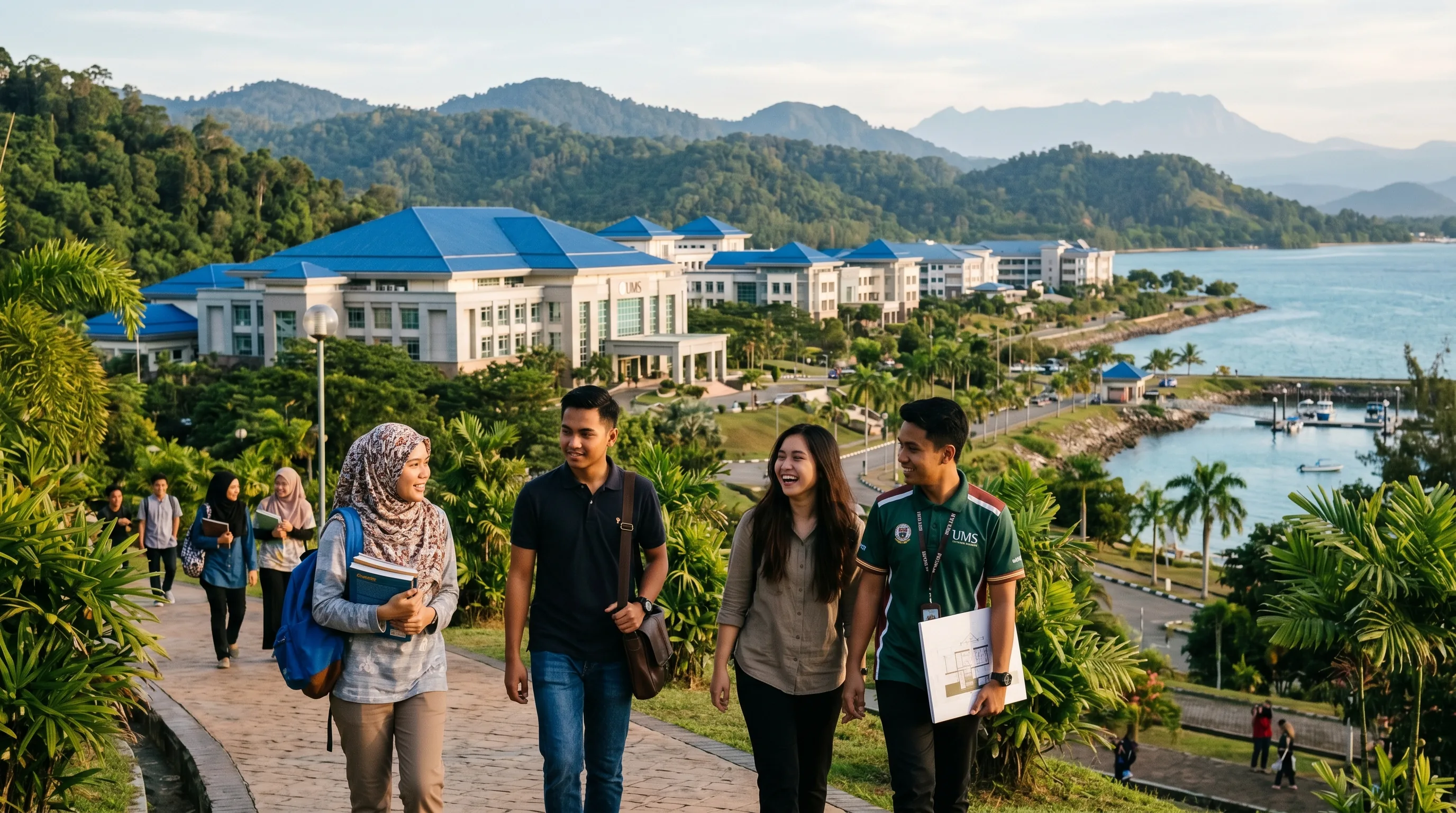
Universiti Malaysia Sabah (UMS): A Complete Guide
What is Universiti Malaysia Sabah (UMS)?
Universiti Malaysia Sabah (UMS) is a public university founded in 1994 on a 999-acre coastal campus at Sepanggar Bay near Kota Kinabalu. It enrolls 13,000+ students and is Sabah's flagship centre for tropical and marine research.
What is Universiti Malaysia Sabah (UMS)?
Universiti Malaysia Sabah, almost always shortened to UMS, is the flagship public university of the state of Sabah and the only full public university headquartered on Borneo's Malaysian side. For anyone living in, moving to, or studying around Kota Kinabalu, UMS is the single most important institution in the state's higher-education landscape — both as a destination for students and as the research engine behind much of what is known about Borneo's tropical forests and seas.
UMS sits at the top of a wide education spectrum in Sabah that runs from village primary schools to vocational training centres and foundation colleges. Where the rest of the system grapples with infrastructure and access challenges, UMS represents the state's academic ceiling: an internationally ranked university with more than 13,000 students, scientists cited among the world's most influential, and a brand-new teaching hospital.
The university is defined by its setting. Its main campus occupies a 999-acre site on Sepanggar Bay, framed by the South China Sea on one side and forested hills on the other. That location is not just scenery — it places the campus within reach of the coral reefs, mangroves and rainforests that form the living laboratories for UMS's best-known research.
When was UMS founded and where is the campus?
UMS was founded on 24 November 1994, making it Malaysia's ninth public university. Its founding Vice-Chancellor was Prof. Dato' Dr. Abu Hassan Othman, who led the new institution as it established its faculties and built out the Sepanggar campus from the ground up.
The main campus is located at Sepanggar Bay, roughly 10 km north of Kota Kinabalu city centre, on a 999-acre coastal site. The campus is large enough to function as its own self-contained town, with residential colleges, lecture complexes, sports facilities, an aquarium and marine museum, and direct access to the bay for marine fieldwork.
The proximity to Kota Kinabalu matters for daily life: students and staff can reach the city's shops, hospitals, the airport and Sepanggar's port area without a long commute, while still studying on a campus that feels removed from urban congestion.
| Detail | Fact |
|---|---|
| Founded | 24 November 1994 (Malaysia's 9th public university) |
| Founding Vice-Chancellor | Prof. Dato' Dr. Abu Hassan Othman |
| Main campus | Sepanggar Bay, ~10 km from Kota Kinabalu |
| Campus size | 999 acres |
| Website | ums.edu.my |
How many students study at UMS?
UMS enrolls more than 13,000 students across undergraduate and postgraduate programmes. Among them are 600+ international students from over 30 countries, drawn in particular by the university's strength in tropical biology, marine science and conservation — fields where Borneo offers research opportunities found almost nowhere else on Earth.
That international mix gives the Sepanggar campus a noticeably diverse character compared with many regional universities. For local Sabahan students it means studying alongside peers from across Asia and further afield; for visiting researchers it means a ready community of collaborators working on the same tropical ecosystems.
Student life is organised around residential colleges on campus, a model common to Malaysian public universities, where most undergraduates live on-site for at least part of their studies. The scale of enrollment also makes UMS one of the largest single employers and economic anchors in the Sepanggar area.
What faculties and schools does UMS offer?
UMS is organised into 18 or more faculties and schools, spanning the sciences, engineering, business, medicine, education, the social sciences and the humanities. The breadth reflects its role as the state's comprehensive public university rather than a single-discipline institution.
The academic offering deliberately leans into Sabah's natural advantages. Alongside conventional faculties such as Business and Economics, Engineering, Computing, Medicine, Education, Social Sciences and Humanities, UMS runs specialist faculties in Sustainable Agriculture and Tropical Biology and Conservation — disciplines that connect directly to Borneo's forests, farmland and biodiversity.
This combination lets a student pursue a mainstream professional degree, such as engineering, business or medicine, while studying in a setting where the university's flagship strengths in tropical and marine science shape the wider research culture of the campus.
UMS's faculty line-up is unusually shaped by where it sits. Faculties in Sustainable Agriculture and Tropical Biology and Conservation exist because Sabah's rainforests, reefs and farmland are on the university's doorstep — turning the surrounding environment into a year-round teaching and research resource.
What research institutes operate at UMS?
Beyond its teaching faculties, UMS runs a cluster of dedicated research institutes that have built the university's international reputation. These institutes focus on the tropical and marine systems that surround the campus and the wider state.
| Institute | Focus |
|---|---|
| ITBC — Institute for Tropical Biology and Conservation | Flagship biodiversity research across Borneo's rainforest ecosystems |
| BMRI — Borneo Marine Research Institute | Coral reef, mangrove and fisheries research along Sabah's coasts |
| Biotechnology Research Institute | Bioprocessing, biofuels and genomics |
| INOS — Institute of Oceanography and Environment | Oceanography and environmental science of the surrounding seas |
The Institute for Tropical Biology and Conservation (ITBC) is the university's flagship for biodiversity research, while the Borneo Marine Research Institute (BMRI) anchors its marine work on coral reefs, mangroves and fisheries. The Institute of Oceanography and Environment (INOS) and the Biotechnology Research Institute round out a research base that is squarely focused on the natural systems of Borneo.
How is UMS ranked internationally?
In the QS World University Rankings 2025–2026, UMS was placed in the #1001–1200 band, putting it among the ranked universities worldwide. While that figure is a broad band rather than a single position, the fact that a relatively young Bornean university appears in the global QS rankings at all is a measure of its growing research output.
A sharper signal of research quality comes from individual recognition: 15 UMS scientists were named in the Stanford/Elsevier World's Top 2% Scientists list for 2025, a citation-impact ranking that identifies the most influential researchers in their fields globally. Having 15 researchers in that top 2% concentrates a meaningful pool of high-impact academic talent in Sabah.
Together, the institutional ranking and the individual citation recognition tell a consistent story: UMS punches above the weight expected of a 1994-founded regional university, largely on the strength of its specialised tropical and marine research.
What is UMS Hospital (HUMS)?
Hospital Universiti Malaysia Sabah, or HUMS, is the university's own teaching hospital — and a landmark for the whole region. It is the first university teaching hospital in East Malaysia, a 400-bed facility intended to train medical students while delivering care to the surrounding community.
The hospital has been opening in phases. Its Primary Care Centre opened on 12 December 2025, with full hospital operations targeted for the second quarter of 2026. Once fully operational, HUMS will give UMS medical students a dedicated clinical training environment on their own campus rather than relying solely on external hospitals.
For Sabah more broadly, a 400-bed teaching hospital represents a significant addition to healthcare capacity in a state that has historically faced gaps in medical infrastructure. The phased rollout reflects the scale of standing up an entirely new teaching hospital from scratch.
What is the UMS Labuan campus?
In addition to its main Sepanggar campus, UMS runs the UMS Labuan International Campus, established in 1999 on the federal territory island of Labuan. Its coastal setting has earned it the nickname the "Beach Campus."
The Labuan campus has a distinct academic identity from the Sepanggar headquarters. Rather than the tropical and marine sciences that dominate the main campus, it focuses on business, finance and international studies — disciplines aligned with Labuan's role as an offshore financial centre. The campus serves as an academic partner of the Labuan International Business and Financial Centre (LIBFC), linking student training directly to the island's finance industry.
That split gives UMS a useful breadth: a research-intensive science campus near Kota Kinabalu and a business-and-finance campus embedded in one of Malaysia's offshore financial hubs.