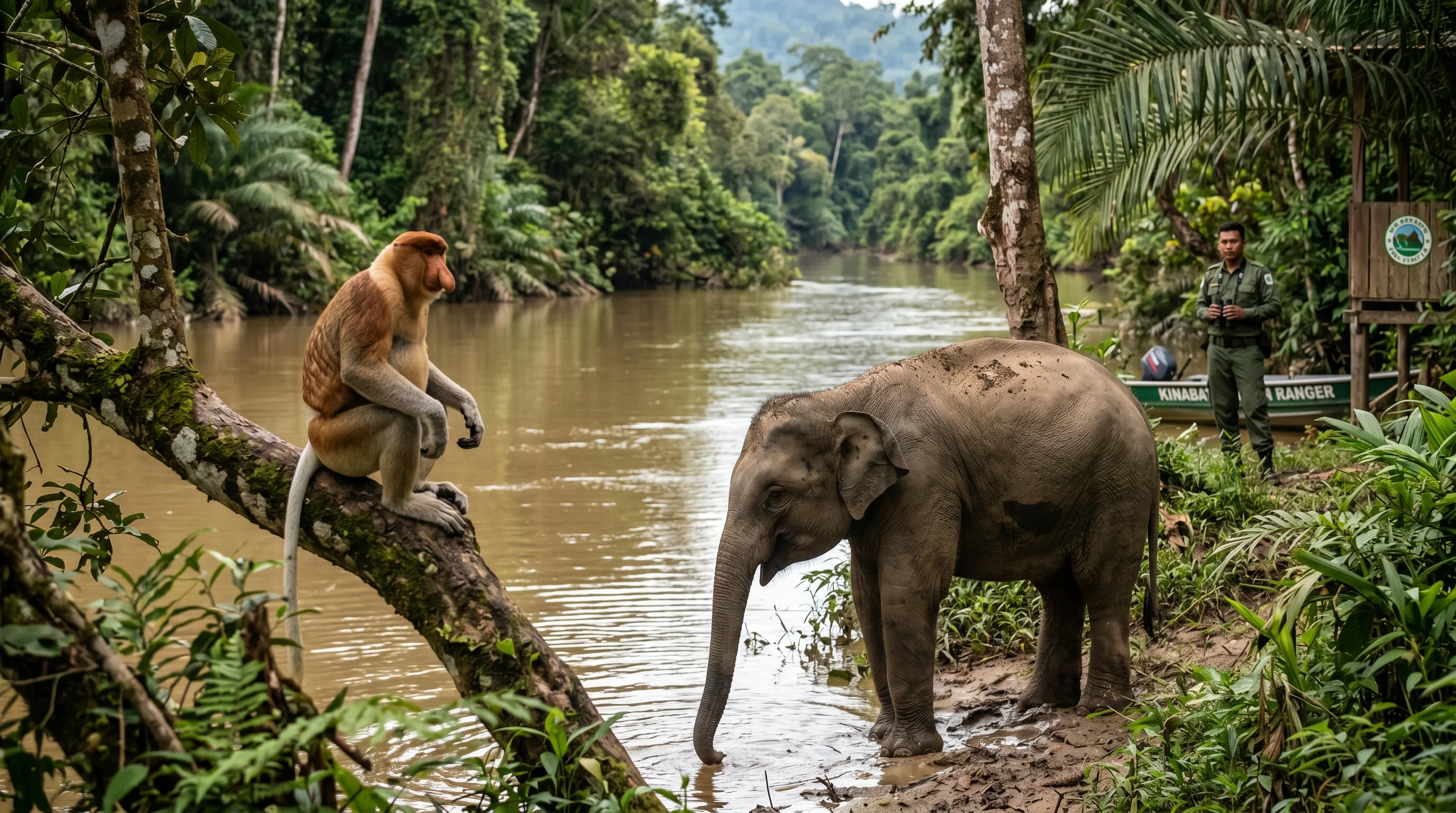
Sabah Wildlife Laws: Protected Species & Penalties
How does Sabah protect its wildlife?
Sabah protects its wildlife mainly through the Wildlife Conservation Enactment 1997, enforced by the Sabah Wildlife Department. The law protects iconic species such as the pygmy elephant, orangutan and pangolin, and sets fines of RM50,000 to RM100,000 and jail terms of six months to five years for hunting them. Forest habitats are governed separately under the Forests Enactment 1968.
The Wildlife Conservation Enactment 1997
Sabah safeguards its remarkable biodiversity chiefly through the Wildlife Conservation Enactment 1997. This is the central piece of state wildlife law, and it sets out which species are protected, what counts as an offence against them, and the penalties that follow. Enforcement sits with the Sabah Wildlife Department (SWD), the agency responsible for investigating offences and managing the state's protected animals.
The enactment matters because Sabah is home to species found in few other places on earth, several of which are under serious threat. By naming protected species and attaching real consequences to harming them, the law gives the state a clear basis for protecting animals like the orangutan and the pygmy elephant. For residents, visitors and businesses, the message is straightforward: certain animals are legally protected, and interfering with them carries significant penalties.
This page explains Sabah's wildlife and forest laws in plain terms for general understanding only. It is not legal advice. If you face a specific situation — a permit question, an enforcement matter, or any dealing involving protected species — consult a qualified Sabah-admitted lawyer or contact the Sabah Wildlife Department or Sabah Forestry Department directly.
Protected species in Sabah
The Wildlife Conservation Enactment 1997 protects a number of Sabah's most iconic and threatened animals. Among the key protected species are:
- Borneo pygmy elephant
- Proboscis monkey
- Orangutan
- Sun bear
- Sunda pangolin
- Rhinoceros hornbill
- Leatherback turtle
These species are emblematic of Sabah's rainforests, rivers and coasts, and several are recognised globally as threatened. Their inclusion under the enactment means they cannot be hunted, harmed or traded freely, and that any offence involving them is treated seriously by the authorities. For visitors, the simplest rule is to observe these animals only in the wild or at recognised conservation sites, and never to capture, harm or buy products derived from them.
Penalties for hunting and trafficking
The penalties for offences against protected species are substantial. Hunting a protected species can bring a fine of RM50,000 to RM100,000 per offence, imprisonment of six months to five years, and confiscation of equipment used in the offence. These penalties apply per offence, so the consequences can mount quickly for repeated or serious breaches.
Trafficking is treated even more severely. Beyond Sabah's own enactment, wildlife trafficking offences carry additional penalties under the federal Wildlife Crime Prevention Act. In other words, someone involved in trafficking protected wildlife can face both the state penalties under the 1997 enactment and further federal consequences. Together, the state and federal frameworks are designed to deter both opportunistic hunting and organised trade in Sabah's wildlife.
Conservation programmes
Alongside enforcement, Sabah runs active conservation programmes that work to protect and recover threatened species. These include the Kinabatangan Orang-utan Conservation Programme (KOCP), which focuses on orangutans along the Kinabatangan; pygmy elephant translocation programmes, which move elephants away from conflict areas to safer habitat; and hornbill nesting box programmes, which support hornbill breeding by providing artificial nest sites.
These programmes show that wildlife protection in Sabah is not only about penalties but also about practical, on-the-ground recovery work. Conservation efforts of this kind complement the law: where the enactment deters harm, programmes like KOCP and the translocation and nesting-box schemes actively help populations survive and recover. For visitors interested in supporting conservation, engaging with recognised, lawful programmes and sites is the responsible way to do so.
Forest reserves and the Forests Enactment
Wildlife depends on habitat, and Sabah's forests are governed by their own law: the Forests Enactment 1968 (Sabah), which oversees forest reserves and is enforced by the Sabah Forestry Department. About 3.6 million hectares — roughly half of Sabah's land area — is Permanent Forest Estate. This estate is divided into protection forests (Class I, no logging), commercial forests (Class II, licensed timber) and amenity forests (Class VI, recreation and tourism), so different reserves serve different purposes.
One notable example is the Deramakot Forest Reserve, which is managed under Forest Stewardship Council (FSC) certification. Deramakot regained its FSC certification in March 2024, after a lapse during the 2019 to 2024 period. The forest classes and certification together illustrate how Sabah balances strict protection, regulated timber use and managed recreation — all of which shape the habitat on which the state's protected species ultimately rely.