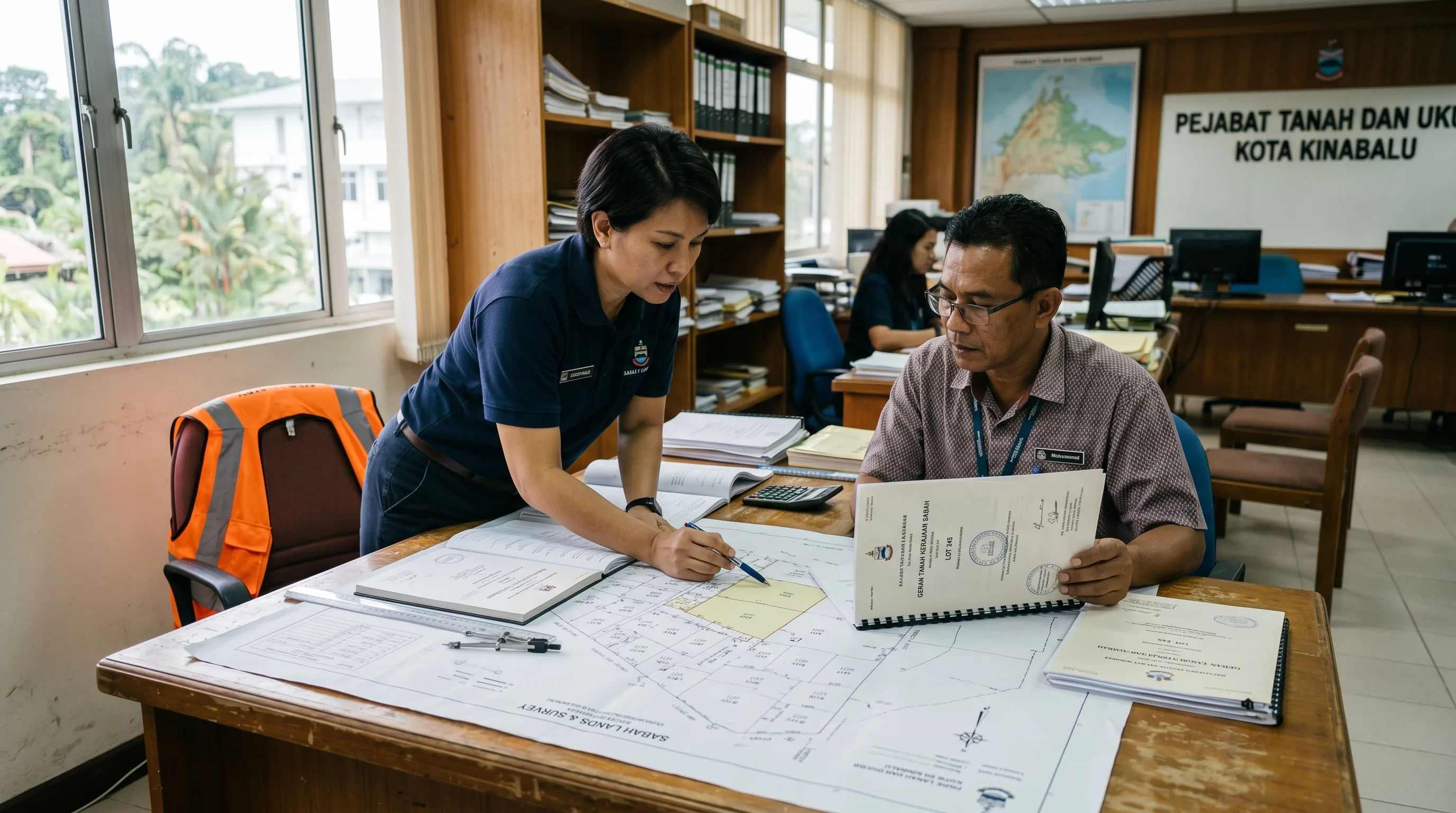
Lands & Survey Department Sabah: Titles & NCR
What does the Lands and Survey Department in Sabah handle?
The Lands and Survey Department administers land in Sabah — titles, subdivision, conversion, premium and surveys — under the Sabah Land Ordinance (Cap. 68), a state law distinct from the National Land Code, including Native Customary Rights land.
Lands and Survey at a glance
The Lands and Survey Department (Jabatan Tanah dan Ukur Sabah) is the state authority responsible for land in Sabah. It registers and issues land titles, processes dealings and conversions, collects land premium, and maintains the official surveys and maps that define every lot.
Because land is a state matter, Sabah administers it under its own legislation rather than the rules used in Peninsular Malaysia. For property owners, buyers and developers, the department is the central point for anything that touches a title or boundary.
This page explains the department's role in plain terms. Land transactions can be complex and carry legal and financial consequences — for a specific case, consult the department or a licensed professional such as a lawyer or registered surveyor.
The Sabah Land Ordinance
Land in Sabah is governed by the Sabah Land Ordinance (Cap. 68). This is a key difference from Peninsular Malaysia, where land falls under the National Land Code. The two systems use different terminology and procedures, so guidance written for the Peninsula does not always apply in Sabah.
The Ordinance sets out how titles are created and registered, how land may be dealt with or charged, and how the state grants and conditions land. It also frames Sabah's distinctive treatment of native land, covered further below.
Land titles and dealings
The core service is the land title — in Sabah commonly issued as a permanent title (Hak Milik Kekal), among other categories. The department registers ownership and records dealings such as transfers, charges (used as security for loans) and leases.
When you buy or sell property, the transaction is reflected in the title register held by the department. Keeping title details accurate matters: it is the official record of who owns the land and what conditions attach to it. The department also administers land premium through its revenue function.
Subdivision, amalgamation and conversion
Land is rarely static. The department handles subdivision (splitting one lot into several), amalgamation (combining lots into one), and conversion (changing the approved use, such as agricultural to residential or commercial).
Each of these changes the legal description of the land and usually involves survey work, conditions, and often a premium payment. Developers and individual owners alike apply through the department, which assesses each request against the Ordinance and planning requirements.
Native Customary Rights land
One of the most distinctive parts of Sabah land law is Native Customary Rights (NCR). Sabah operates a Native Title system under the Land Ordinance, recognising land that natives hold through customary use and occupation. This framework differs significantly from both Peninsular Malaysia and neighbouring Sarawak.
NCR matters can be intricate, involving questions of customary use, documentation and native status. The department processes native title applications and related certificates, and District Offices often play a role in rural cases.
NCR and native title cases are legally sensitive and fact-specific. This page is educational only. For any actual claim or dispute, engage the department directly and seek qualified legal advice.
Surveys, maps and contacting the department
The survey side of the department produces cadastral plans, maps and boundary surveys that underpin every title. Accurate survey records prevent boundary disputes and support orderly development across Sabah's districts.
The department is based at Bangunan Negeri, Jalan Tuaran, Kota Kinabalu, with the line 088-486 400 and the website jtu.sabah.gov.my. For land in other districts, the relevant District Office may handle lower-value transactions and certificates. Always confirm current procedures and fees before lodging an application.